Reviews, Interviews and Articles


July 1, 2007
Ten Famous Canadians
Canada's best-kept secrets in the arts
Globe & Mail
-- Canada's national newspaper


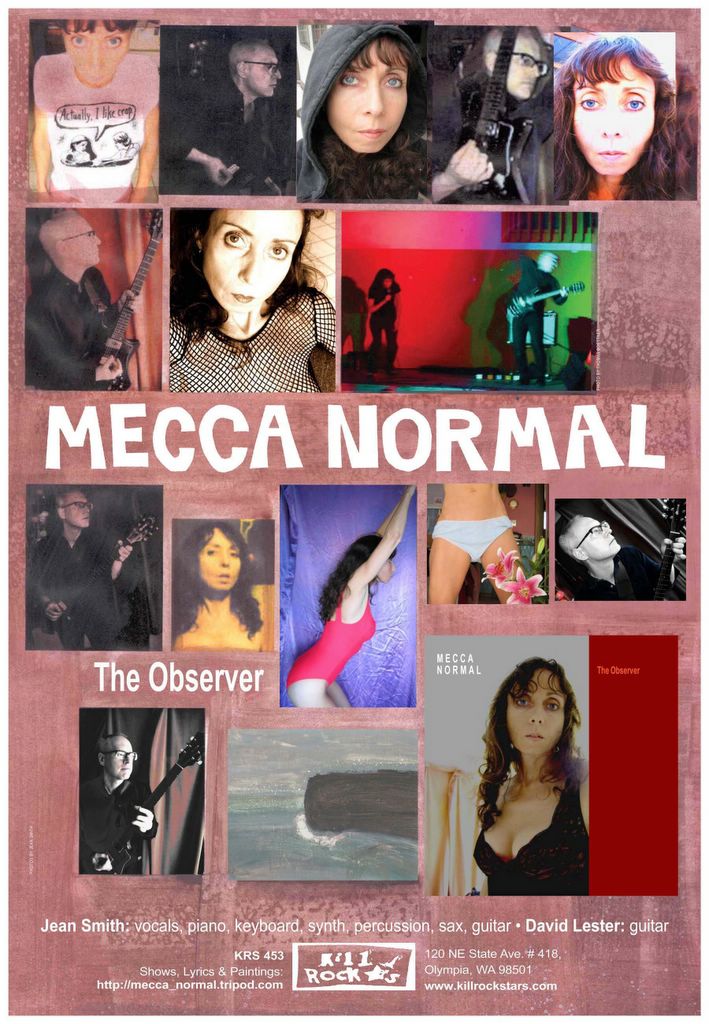
The Observer

“Musically, Jean Smith and guitarist David Lester have grown far beyond their punk rock beginnings; now their instruments wheel and dip around each other with the dizzying grace of swallows.” -- Bill Meyer, Chicago Tribune

“After turning their talents to other pursuits - painting and writing - Jean Smith and David Lester are back in full acerbic force on "The Observer," one of their best albums.”
-- Evelyn McDonnell, Miami Herald

“Smith is a writer of supremely fresh poetic skills and has a keen, keen eye for the basic incredibilities of our most mundane daily rituals and heartbreaks.” -- John Payne, LA Weekly

“…her use of precise language and thoughtful candor creates an unexpectedly mature, graceful tone more reminiscent of a Raymond Carver short story.
-- Hannah Levin, The Stranger (Seattle)

“Smith's reflections are smart, funny and -- more often than not -- yoked to music that's spare but inventive.” -- Mark Jenkins, Washington Post

"Attraction Is Ephemeral," which provides the most complete picture of Smith and what she’s about—the way she begins to doubt her own doubts, wondering if she’d be able to spot genuineness in a man even if it were there—is also the most musically moving track on the album. It’s the most romantic too—or rather, it’s most explicitly about romance, or at least the yearning for it—though in typical Mecca Normal fashion, it opens up from there, addressing gender and class inequality, patriarchy, and how they can really ruin a date.”
-- Jessica Hopper, Chicago Reader

“The self-explanatory album opener, "I’m Not Into Being the Woman You’re With While You’re Looking for the Woman You Want," is a glowing example of the interplay between her vocals and Lester’s guitar, which is equally distinctive and powerful.” -- Jessica Hopper, Chicago Reader

“…this new CD, full of songs inspired by Smith's online matchmaking experiences, I believe, is incredibly lyrical, musically rich and undeniably fearless." -- Terence Dick, Broken Pencil

---------------------

December 27, 2006 letter from J. Free

I've been adding archival content to my website, I came across an old interview I conducted with Jean, during the International Pop Underground convention in Olympia, in 1991:
http://sonicarchives.com/TASTE/Pages/npr_meccanormal.htm

Take care, J. Free
http://www.sonicarchives.com/

-----------------------------------------

Simple Social Graces, NY blog:

From practice I went to the Knitting Factory with Brian to see Mecca Normal play and it was such a treat. Mecca Normal is band of complete inspiration to me. First of all Jean’s truly original voice and style of lyrics writing and presentation of it all, and secondly David’s virtuosity on guitar and the sweetness with which he plays. I hadn’t seen them in years and it was so good to chat and smile and hear about what they are doing and it reminded me so much of the first MN 7” I had where inside Jean wrote something like you can’t be a threat when you are numbed which spoke to me enough that I stopped drinking for 4 years because at that time I wanted to be as much of a threat as possible. For the last 20+ years they have lived mostly outside of the music “business” but always inside of the music and this is important to me. Music for music. Because it’s the best thing in the world.

-----------------------------------------

2006's most memorable moments:
The year in movies, music, television, visual arts, fashion, performing arts and architecture
BY MIAMI HERALD STAFF
POP MUSIC:
-- Tanya Stephens, Rebelution -- Covering topics from homophobia to religion to Condi Rice to cherry brandy, this reggae singer proved Bob Marley's spirit lives, 25 years after his death.
-- Gnarls Barkley, St. Elsewhere -- Defying genre-ization and politesse, this album captured the explosion when two brilliant minds meet.
-- Dixie Chicks, Taking the Long Way -- The Texas trio knows the price of speaking one's mind -- and that it's worth every penny
-- Lady Sovereign, Public Warning -- A great rap and punk record.
-- The Paybacks, Love, Not Reason -- Wendy Case is a great rock 'n' roll singer, these songs pure bottled energy.
-- Jay-Z, Kingdom Come -- Knew he couldn't stay away from the game; glad he didn't.
-- Morning 40 Federation, Ticonderoga -- When the saints don't come marching in, the sinners will.
-- Mecca Normal, The Observer -- For two decades, Jean Smith has been a wry chronicler of male/female relationships, but rarely has she been so tender and intimate.
-- Prince, 3121 -- This survivor success story is the album that should have been titled Kingdom Come.
-- Bruce Springsteen, We Shall Overcome: The Seeger Sessions -- Making a history lesson a party, and visa versa.

-- EVELYN MCDONNELL, Posted on Sun, Dec. 24, 2006

-----------------------------------------

Guest lists: What 29 of the Boston Phoenix's music critics liked this year

December 21, 2006
Franklin BRUNO

1. Mecca Normal, THE OBSERVER (Kill Rock Stars)
2. Scritti Politti, WHITE BREAD BLACK BEER (Nonesuch)
3. Ornette Coleman, SOUND GRAMMAR (Sound Grammar)
4. Kelis, KELIS WAS HERE (La Face)
5. Mission of Burma, THE OBLITERATI (Matador)
6. Jason Moran, ARTIST IN RESIDENCE (Blue Note)
7. Erase Errata, NIGHTLIFE (Kill Rock Stars)
8. De La Soul, THE IMPOSSIBLE MISSION MIXTAPE (AOI)
9. Wussy, FUNERAL DRESS (Shake It)
10. T
om Verlaine, SONGS AND OTHER THINGS (Thrill Jockey)
-- The Phoenix (Boston), 2006

Broken Pencil
"In the past I've liked the idea of Mecca Normal a bit more than I've liked their music. That said, I would never turn down an invitation to see them live. Watching singer Jean Smith stalk the stage and guitarist David Lester dance (and I mean dance) his manic guitaristics, you quickly realize how little it takes to make impassioned rock'n'roll and how few bands manage to do it. On record, however, I miss the presentness of it. That said, this new CD, full of songs inspired by Smith's online matchmaking experiences, I believe, is incredibly lyrical, musically rich and undeniably fearless." --Terence Dick


MECCA NORMAL

Interview conducted in the Spring of 2006 at Jean Smith’s comfortable abode over tea and much laughter (just intersperse the asides of laughter yourself) shortly after the tour and release of their latest album “The Observer” on Kill Rock Stars. This is album number twelve in the over twenty year long career of this duo that consists of Jean Smith (vocals) and David Lester (guitar).

Dayton: How was tour?

Jean Smith: It was brutal but it was great. The last half was with Shoplifting, we were opening for them, they’re on Kill Rock Stars.

Dayton: I’ve heard the name.

Jean: They’re fantastic, a singing female drummer who does duets with the lead singer, excellent guitar player. They were great to hang out with night after night.

Dayton: That makes it easier-

Jean: -for them. They’ve got the van and two drivers. In our band we’ve got me as the driver.

Dayton (to David): You don’t drive?

David Lester: Mm mm.

Dayton: Do you have a driver’s license?

David: Yes, I do.

Dayton: But you don’t drive. You’re like me!

David: You wouldn’t want to be riding with me. I’d kill you.

Jean: I like to drive. I’m good at it. Dave has other skills. That’s the great thing about Mecca Normal, it’s not like we’re really similar people, we have different skills and that’s why it works. We did twelve shows in ten days in a different city.

David: We did an evening in Providence after sleeping in a weird flophouse.

Jean: Weird? It was filthy. Someone’s showing you through the room with the guys with the huge bottle of Jim Beam, you’re walking over broken furniture and past spilled glasses of ancient soda pop and into these rooms where you’re supposed to each choose which room hoping they get better as you go up through this house, right? “Okay, do you want this room here with the bedding that has guitar cables mixed into the sheets.” You all get these rooms. Somebody’s got to get the alarm clock because you have to get up at 6:30 or seven to get to this radio show, it’s already like 3:30 in the morning.

Dayton: At least you’re a duo. Travelling as a duo would be relatively easy. Did you ever book hotel rooms?

Jean: You do need to have a bit of a break. We only took-

David: -three motels in the whole three and a half weeks. The rest of the time we lived on the good will of the people taking us home with them.

Jean: There was one show in Portland, it was a big show opening for Mates Of State, you know those kinds of shows where people don’t know who the Hell you are, a few people do, they’re just absorbing this, it’s not your thing, right, you’re on the bill for some reason. Do you know The Mates Of State? They were very nice. They’re quite happy and poppy and they’re a couple who like each other and they reveal this to the audience. The woman came bopping across the parking lot to me and said, “You did that Michael Jackson cover back in the 90’s, didn’t you? I saw you in Lawrence, Kansas.” I’m thinking, “Oh my God, we’re on this bill for some reason. No, we never did a Michael Jackson cover and we weren’t in Lawrence, Kansas in the 90’s. How did we even get on this bill?” I didn’t say any of that to her, of course. I had to ask from the stage if somebody would come up to us and give us a place to stay. We simply had nowhere to stay. At the end of the night we sort of got this message and directions but we didn’t know where the Hell we were being directed to but it turned out to be great. She had pitchers of the water on the nightstand and little candles going and beds and everything was wonderful.

David: She was incredible and she had all of our CDs. It wasn’t like she was just being nice and taking pity. She was actually a fan. But that’s contrasted with Baltimore where we slept at the venue which was an old, kind of abandoned warehouse that artists we’re living in. Jean lent me her guitar case, I was going to go sleep in that or on the floor amidst cigarette buts and dirt.

Jean: The party raged on another hour and a half after the last band played and you’re just dying to get some sleep.

David: We had one day where Jean drove in five States. What a day.

Jean: And that was the day…sometimes we involve other people in our dynamic, in this case we involved an avant garde composer who I was going to work with and we created this band on the road so we were going to meet him, get him in the car and go and do a show that he and I would play and for the next four shows together with this person that we had never met and didn’t know what the Hell was going to happen. It was very exciting and it turned out to be very great. We do have a history of disrupting this entity by involving other, either duos or poets or minimalist musicians.

Dayton: It keeps it fresh.

Jean: It livens things up if it works okay, it can be energy draining if it doesn’t.

Dayton: More times than not it works, right?

Jean: You become a team in a really interesting way. Everybody has to not let their end down. It’s a real little community. Musicians are an example of what is hopeful about society in that we all have to want to play with other people so you have to socially interact in a pleasant manner. Otherwise you’re not going to have anybody to play with.

David: Unlike writers or painters where it’s a solitary function.

Jean: They can afford to be more prickish.

David: Bitter, angry.

Dayton: Besides the musical practice you both do the solitary artistic practice.

Jean: They overlap. We put out our art show and we do a Mecca Normal performance at the exhibit and we do a workshop or a lecture, depending on the environment, called “How Art And Music Can Change the World.” We also get up and talk about our art to people. We don’t just put it up, have the opening, act weird at the opening, and run home again.

Dayton: And be prickish.

Jean: Be prickish about it all. And we do it for maybe other reasons than just pure self expression. It is based in social values of expressing political concerns directly as Dave’s series of posters, “Inspired Agitators”, does. He’s selected a group of activists and cultural luminaries from throughout history and does these great posters that give an idea of what these people set out to accomplish and something about their lives.

Dayton: Aren’t these posters meant to be viewed as part of a play?

David: We did put them as part of a play that involved both our works, my politicized word based work and Jean’s non-verbal based art.

Jean: We realized that once we had all of this art accumulated we had switched roles, Dave is the musical non-verbal part of Mecca Normal and I’m the very verbal singer. My paintings are not really language based or even strongly concept based. We created this art show in a few different environments where we just dealt with the space and created a linear sense of what it would be like if it was a play. You’re walking through it and there’s these different components, you see the playwright and the playbill, paintings of what the set looked like, you see political art and non-political art. The basis of the play and the art exhibit was, “Do people like political art because they agree with it? And what is the value of art in society and does it have to have a message and that kind of push and pull within?” We were exploring those ideas as well because I felt some responsibility when I realised my art wasn’t really saying something. I thought, “That ain’t right for a politico in Mecca Normal to just create images that were based on things that were quite likeable. You know, colour and light and composition.” That’s my inclination with painting to a large extent. And it was also about teamwork. It was called “Inspired Agitators And the Pantomime Horse.” So who was going to be the front of the horse and who was going to be the back end of the horse in the duo? The arguing, we created a costume, it was a neat exercise. We did that and created the lecture around that and then did the songs, we created this spectacle on many levels. Another component was my self-portraits which I started at age thirteen and continued up through the years in between of my life. I talk about how I was as a teenager and why I was doing these and to encourage young people to start something and you never know where it’s going to go, to keep doing something, to not just think it’s all hopeless.

Dayton: With regards to the show’s mandate, are you asking, “Are we preaching to the converted?”

Jean: Welllll, in a way, I didn’t ever think of it in that way specifically but more the essence of the question, “If you see a painting that says ‘war is wrong’ are you liking the painting because of that message? Is that what is valuable to you about that piece of art and therefore should art be giving us direct messages or is there something about it that is intrinsically valuable because of how we interpret it on an intellectual level or another less literal level?” That we get different things from it is a neat thing.

David: Combining our art works where mine’s more explicitly political than
Jean’s, I think there’s room for both ways of looking at it. I don’t think you can exclude things because they are colourful or beautiful or they speak to you in a different way. Maybe that’s political, maybe they’re out to have a positive resonance to you in your life and that’s as political as saying “War is bad” or whatever. I think that combining our artwork is a challenge to the audience, I think juxtaposing them together is part of what we’re doing with this show.

Jean: Actually that’s an interesting thing about the guy I’m working with in this band that’s going to continue on called Book Of Common Gestures. David First is a composer and he’s done quite a bit of work with microtonal drones that he’s established make people feel good. He creates these pieces that he has technically figured out which waves make you feel a hell of a lot better. They’re not telling you to feel better or creating pop structures that dance around that do another kind of feeling better. He’s finding scientific, biologically physiological evidence as to which sounds. To me, that’s political, that you want people to feel good, you want them to feel better. And I think Mecca Normal has gone more in that direction where after all these years we don’t feel we have to tell people how to be, how to think. We’re willing to present new songs that are more vulnerable just through the confidence of what we’ve already created together, there’s a lot of different levels to offer from.

Dayton: I’ve definitely noticed with the new album that it’s less jagged and jarring.

Jean: I think that I’ve got the long narrative form down pretty good for some of the songs. I guess it started on the last album, “The Family Swan”, there was a few long narrative pieces. For this one, the one song “Attraction Is Ephemeral”, it’s the last song that we did, I just had this story that I worked along time on, we just sang it once and taped it, it was done, now we just had to do it the same way in the studio, that was the second time we did it.

Dayton: Mecca Normal has been together for twenty years. Was this a conscious change to move in this direction?

Jean: There was no master plan.

David: Just the idea that Jean was moving in the direction of longer narratives, songs that were eight or nine minutes long, that in the course of that I thought that we should have some variation, it’s hard to play the guitar for that length of time.

Jean: Hard in what way?

David: As a listener I’d rather hear other things happening within that. For repeated listenings I just thought that we could expand and have a bit more fun in the studio to accommodate the longer pieces.

Dayton: This was recorded at The Hive. Have you recorded there before?

Jean: This is a new thing. We discovered The Hive when we were doing a
project on our own label a few years back. We went in there and worked with Jordan Koop and he really got the sound right away that we liked. When it came to do this album he made us feel creative because he got the sound that we wanted really quickly. We get there and I’m thinking, “If this guy becomes bizarre over the content of these songs….” It is revealing stuff but actually I’m a fairly modest person and I don’t really have an urge to expose myself or anybody else. This was just stuff that was going on with the online dating. People have asked me, “Oh! Great idea! So then you went and researched it?” No, I was trying to get a date, you idiot! But Jordan made the environment so creative. He wasn’t judgmental at all. We just behaved as ourselves and he didn’t disrupt that dynamic which I think is a real skill. He was just so great.

Dayton: Tell me more about the recording process.

Jean: We had these meetings and we decided to add these elements which were predominantly things that I was going to do: play some acoustic guitar, electric guitar, sax, piano, percussion of some sort- that was pretty much a failure with my efforts of playing the drums, it sounded really good when I was doing it, it sounded pretty bad when I played it back but everything else worked. Even though doing it would play the sax over the whole song and I think Dave’s going, “Oh my God, what is she thinking?” But the idea was that somewhere in there, there would be some notes that worked and everything else went out.

David: We thought it was going to be all the way through. We weren’t privy to that information.

Jean: With the piano, I thought the same thing is going to happen here. I think we used almost all of the piano, it was one of those days where it sounded good. I used synth and a Casio keyboard for drones and stuff. I felt happy and proud that I’d accomplished this mission to not to subvert the composition nor detract from Dave’s guitar or my vocals- but to create some kind of tension. We were calling them tasty bits. These things would appear to give the listener more freedom. It was making music was what it was. That’s what we did. Yeah! That’s what we did!

Dayton: Which you’ve been doing since 1985 when you guys formed. Am I correct?

Jean: Maybe 1984.

Dayton: Would you have had any idea that you’d be together this long back then?

Jean: I didn’t even know it was possible to live to this age let alone be a band.

Dayton: Did it just seem natural to keep going?

Jean: It’s never really come up. We’ve also allowed other things to happen in life. It’s always been a great way to reconnect and develop further. It’s like my self-portrait series where you get to now see your whole life in this limited vantage point of the same thing. It’s like having a great photo album of your thinking and your expression. There’s a great deal to be said in favour of continuing artistic projects and to maintain partnerships in that way. I think Dave and I have found ways to create enough variation by including visual art. With the writing Dave does a lot of my editing and some publishing of my work. We’ve developed all of these additional yet inclusive kind of functions.

Dayton: They are all extensions of your practice.

Jean: I probably shouldn’t say this but on one of my tax returns I wrote off one hundred percent of my place and one hundred percent of my time. If they were going to ever ask me about it I would just say that I write about my dreams so the bedroom’s included and while I’m asleep it’s included. They went for it.

Dayton: With Mecca Normal you have kept the same basic dynamic since the beginning: vocals and guitar. I would be correct in assuming that. This is substantiated fact.

Jean: There’s evidence! Lots of evidence!

Dayton: Have you been able to look back on the work and notice how it has changed along that continuum?

Jean: Because I live inside my own mind and all that that entails I notice more my attitude and how it’s changed in a psychological evolution. There’s nothing that we’ve done that we cringe at.

Dayton: Really? I go back even five years ago and find stuff that I have done that I cringe at. Really?

Jean: No. I like listening to what we do. I wouldn’t recommend that anyone should listen to it as much as I do. We’re meant to be an additional complementary entity to what else is out there, we’re commentary in a way on what else is happening, we’re a response. People will say to me about this new album for instance, “Whoah. You’re just willing to expose anything.” I’m thinking, “I don’t really expose much of anything” but I’m getting the impression that something is being interpreted by the listener’s own doing that it’s bringing up something about their circumstance or experiences in that way. There’s nowhere really on the album that it is mentioned that this is online dating. These are just romantic encounters. In fact there is one song that has simply nothing to do with online dating but I would challenge anyone to determine which one that is. We’ve had a couple of reviews that sort of say, “Ew, creepy” which is kind of neat, I like that reaction in a way because I wanted to bring up the controversy of being 46 and feeling attractive and good in life, that I’ve worked some things out and am probably better now than other times in life. At this age you’re not viewed as desirable or attractive within the demographic that society puts forth as what women are, what sexy is, sexy ends at a certain age. I wanted to bring that up. The photo on the album cover is not specifically meant to be glamorous. It is supposed to be more vulnerable and that there is something else to what is going on than just the dynamic of putting out something as sexy as possible visually.

Dayton: There is a certain amount of ageism in our society.

Jean: And rock music is about-

Dayton: The young and-

Jean: Yeah. If a reviewer is going to say “This is creepy”- also because I’m known as a cultural activist or a feminist it seems like that’s been such a limitation to how I’ve ever been described in the media or how people see a woman onstage, “Oh, she’s pretty heavy and tough”, that you couldn’t be also hilarious and totally attractive or sexy or whatever. You’re allowed one sort of dimension. If you’re a feminist or you’re political that tends to exclude a lot of other complexities that all people are made up of. I wanted to bring those things up. It’s been really neat doing these songs live because it almost seemed that people are really laughing a lot at these songs.

Dayton: Well, they’re very funny.

Jean: I’m typically very funny. I was more funny when I was drinking which all ended about seven years ago. There’s that transition to being totally sober onstage and a little bit awkward. To have people really laugh at particular lines within a song, first of all they’re really listening, they’re following the narrative and then they look around like, “Oops! Am I supposed to be laughing? This is serious stuff, this is a known feminist.” By the end of the tour that’s how I became more the way I sang it, not as stand up comedy, I knew where people were going to laugh so I allowed for more room to savour the laughter.

Dayton: Because it is so confessional it is at times very wry and flippant. It’s two different kinds of putting yourself out there entwined: putting yourself out there with the album and putting yourself out there with having a LavaLife profile.

Jean: What happened specifically was even when these dates didn’t work out I felt at least that I could write about it, that there’s some inspiration as an extension of trying to understand not as sort of like “Man, that guy was a stupid asshole, I’m too good for him anyway.” I really steered clear of propping myself up in ego based taking things personally as far as why it didn’t work. I wanted to understand more about what was happening. Writing for me is always an extension or a different way to think then you have a document of that, you can watch yourself being accountable to what really happened. I felt that was a valuable part of the experience. Also because you’re learning about the person originally before you meet in the written word which I think is a valid way, especially for me as communication is an important part of the type of person that I would be looking for. Can they communicate? How do they communicate in the written language? Some of the things that happened on these dates, or the little romances if they extended beyond dates, I just found that I learned so much. I just found opportunities to deal with other issues in my past that I maybe hadn’t known how to really process and define. Things like if a person was being disrespectful to me I think in the past I would try to prove myself or that it’s a challenge or that there’s some sort of attraction that is unhealthy or not particularly positive to different types of personalities. It felt like I was finding people to see that really clearly or quickly because I’d done this sort of work when I quit drinking…this is getting all heavy! David’s starting to fall asleep, he’s heard this so many times!

Dayton: We’ll get to you in a minute, David.

David: She’s on a roll.

Jean: Okay so I quit drinking but I wanted to figure out why I drank in the first place, why I started drinking at age thirteen and went through life using that as a way to avoid feeling pain so I examined a bunch of stuff and figured out some stuff and put it into use. It felt like the universe was giving me the opportunity to deal with these things really quickly and I had this clarity of, “Oh! This guy actually is being disrespectful to me!” and to not take that personally, that’s what he’s doing, that’s all to do with something in his life that he does that to people for things that he hasn’t figured out about himself. It doesn’t mean that I should stay there and make excuses. What I need to do is say, “You’re disrespectful to me. I cannot see you again.” Setting boundaries, right? I won’t allow myself to be in that situation. And then the guy of course goes, “You’re a mental patient!” Well, that’s obvious because you’re disrespectful to me, so one last time on the billboard with the flashing lights I go “So I’m right” and then you don’t see that person again.

Dayton: With these healthier trains of thought do you think it is easier to not dwell on things because it has been arranged through a computer?

Jean: I don’t know really because a couple of these people I did continue to interact with because they were more around my age and they were trying to figure things out yet they were still doing these behaviours that struck me as not good for me so I did continue to communicate with them online to try and continue some of the dynamic which is also interesting, where you might not want to get together over coffee but it did seem like there was potential to write more. There’s a potential for intellectual connection where the body is not there, you’re connected to the mind and a lot of social filters are different, the ones that are physically involved with talking are gone and new ones arrive. It seems like with some of those connections you actually give people quite a bit of credit, you want to believe they’re really special and great because you are involved with this discourse without those other filters. And then it bums people out they meet the actual person and they see they’re a mere mortal and they have spinach between their teeth or whatever. It seems like there hasn’t been enough research done on that.

Dayton: I think you’re right, I have noticed that. But on the other hand one might be quicker to dismiss or deglamourize the person if they do something disrespectful out of the blue.

Jean: What kind of things do you mean?

Dayton: I haven’t encountered anyone doing that myself but I have heard about people going over certain boundaries. Now with people saying that your new album’s creepy, I do know that I once put up a dating profile up and I was wary of it and found it a little wary, that there was a taboo. But I don’t see it so much with younger people as computers become much more a part of life.

Jean: And this taboo will dissipate the longer this phenomenon is around and I don’t see it going anywhere. It’s here to stay. In fact, somebody I went on a date with had been doing it for quite a while. In the beginning the pioneers of this phenomenon were more interesting to select from, to get together with, but now there are a lot of followers.

Dayton: Because the pioneers set the template?

Jean: Yeah. That era is now gone. Trying to learn about somebody is part of this thing, too. It’s interesting. I like it. I don’t find online dating that bizarre in any way at all. It’s actually quite convenient. I wouldn’t say I recommend it. I’m not doing it right now and I don’t know if I’ll do it anymore. It’s a bit of hunting and gathering like going into a thrift store. Like, “Who would buy that? Look at this thing.” Some of the things people will write is fascinating on their profile with what they think is going to draw somebody in. That they’re obviously bitter or they’re tentative or they want to talk but they really don’t know what to say or you can start to read the deceptive nature of it. This is another taboo: I have different profiles for different purposes so I’m like a total rebel on these.

Dayton: What were the different purposes?

Jean: One I was just putting erotic writing up without my photo and getting a response from people. And people would write erotic sections, and you can see them trying to create an emotional thing called lust with this writing and that takes some doing trying to make another human feel lust through your construction of cerebral quality. (to David) And it’s not to be mocked, Mr. I’ve Had A Girlfriend for how many years?

David: Eight years.

Dayton: How did Jean approach you with these new songs and how did you respond to it?

David: I guess I’d been hearing about Jean’s involvement on LavaLife and I know she’d been writing about it. She often turns her prose writing into songs so it seems like it was obvious the direction that it would go so that wasn’t weird at all. The subject matter is about human relations if you really want to get down to it whether it's on the internet or however people meet each other, that’s still fundamentally what it’s about and that’s what people write songs about. I think she writes in a very cinematic and receptive way and she has a great usage of language. She’s not restricted by the barriers of how song structures should normally be with choruses and verses and stuff. They have some of those that work in but they work in organically where Jean finds a line that she wants to repeat. She works with that and that’s her decision to come up with it or not but to me they don’t really need it, it still works, it’s catchy still.

Dayton: You have to come up with structures to go with that.

David: I try to create something that she can work with that has a flow to it that she can feel a bit of freedom.

Dayton: These songs are about relations but are most definitely not clichéd “I love you, you love me.”

David: That’s what’s great about it is to take subject matter between men and women that has been done to death to a degree, I think that she does it with an incredibly fresh approach because of the quality of her writing. When I came up with the music to “Attraction Is Ephemeral” it was the exact thing that I love most, it’s just very simple chords with a few little tricks to it and it has a fluidity to it. I thought that as soon as I came up with it that Jean could put a story to it, to do a longer narrative, and it wouldn’t be boring in terms of the music being simple, it would propel itself along, you get certain chord structures and they build upon themselves without seeming to be repetitive and yet they are.

Jean: Thank you for all those compliments, by the way, pal. That’s why you did that so masterfully because when I picked up the piece of paper and just started it was just the perfect version and luckily we recorded it and we learned it from that. When we recorded it in the studio then we learned how to do it live from that. I still can’t really find the beginning or end, it just rolls along, that you can’t really see the seams. That we’ve worked together so long- actually even on the first album I think five out of the twelve songs we’re the first time that we ever did them in that same way. Turned on the tape, Dave played something that I’d never heard before and I sang stuff and that went on the album.

David: To me this is the great thing about working with Jean for twenty years is that she has the ability to do that. You can just start playing and she’ll start singing and it’ll gel. It doesn’t happen every time but it can work. Many people could never do that, they would never have the bravery to just start singing to something, they would want it all worked out in advance.

Dayton: The ability to improvise.

David: Yes, ability to improvise and to be confident doing that and to produce good work that way. Now not every song is like that, we do have other songs with very set structures and changes where we put a great deal of work into it, it’s just a different kind of song, it isn’t better than the one that comes instantly. Jean can do it either way. Again, that makes it exciting.

Dayton: You both have and have had other musical projects. Do you approach them differently?

David: In a nutshell, when I’m working I specifically come up with guitar for when I’m thinking about Jean in our project. I’ve worked with a Downtown East Side poet Bud Osborn that I would think about differently because he does stuff differently. And working with my girlfriend Wendy Atkinson who’s a bass player, we do a lot of improvising together.

Dayton: Can you put your finger on it more?

David: It’s to do with how Jean sings. It’s not that you’re limited by what you do, you keep expanding your own ideas within the context of that. Her artistry affects mine.

Dayton: And Jean?

Jean: In my other projects I tend to play guitar. Depending on the personalities I’ve worked with it tends to inform how the lyrics are dealt with and because I play guitar in these other projects I maybe truncate the lyrics into something to fit that.

Dayton: What about lyrical subject matter?

Jean: I think I’m more comfortable with ambiguity in the other bands, to explore things that aren’t conclusive. With Mecca Normal I tend to take our mandate from the very beginning into consideration at the very least.

Dayton: And that mandate is?

Jean: That I’ve learned things that I want to put across to people to make the world a better place. Ideas about oppression, social issues, poverty, housing, male-female dynamics. Over that time I’ve found other ways than being totally literal that are as valuable and valid, such as respecting the audience and their ability to interpret subtleties and metaphors. And to even interpret it completely other than how I mean it, that because I’m generating something that they will get something and whatever they get is okay with me as a respectful collaboration with the audience. That’s an extension of the mandate and how it’s evolved. With the other projects I feel I’d rather almost not have substantially important lyrics so they maybe get less attention. When you think of (other project) 2 Foot Flame the songs are fairly poetic, the voice is used more as an instrument because there are other instruments, how to fit into a soundscape, maybe vocal drones.

Dayton: Yet with the new Mecca Normal album a lot of the subject matter doesn’t seem to be conclusive.

Jean: I like that about it. I’m not trying to make a case. The song that starts the album, “I’ll Call You”, I did write that as a profile. I was pretty mad at this guy, I thought it was going somewhere but then I saw him online again after we’d been together a couple times which is why I wrote the second song about him as well, he’s not just checking his mail, he’s there for five hours, I don’t get it so I just had to say to him, “I’m Not Into Being The Woman You’re With While You’re Looking For The Woman You Want.” I just had to write that after racking my brain because I didn’t like that feeling. What am I chopped liver?
Plus there’s a whole dynamic of LavaLife where they have these three sections, where they have dating, whatever the hell that is I really don’t know. What the hell is that? And then you never see them again. The middle one is Relationship where I clearly felt like that was not the structure that I…I made a profile for that, I had a profile on Dating and I progressively worked my way on to Intimate Encounters which I found really sort of spooky and slimy when I-

Dayton: -even the name. It’s like Alien Encounters.

Jean: I went in without a photo and wrote stuff and got reactions then I put up a photo and monitored how that went. And then you start being judged as, “Well, you are obviously just having sex with anybody at all if you’re in this section” is the stereotype of it.

Dayton: No, it’s intimate!

Jean: People would assume that because you’re there that it’s just one thing about a person and they weren’t even reading the profiles per se. I had one profile where I said if you’re going to contact me use the word ‘canoe’ so that I know you’ve read my profile. And so many people did not. The guy who I wrote “I’m Not Into being the Woman You’re With…”, I got the impression that because he met me in Intimate Encounters that he pretty well come out and said that who he was going to eventually get together with was someone from Relationship. It’s like I’m the slut from the other side of the tracks or whatever metaphor, y’know, I’m Mrs. Goodtimes. It was really odd.

Dayton: So it is set up with these three categories with a certain set of perimeters that LavaLife does not define themselves?

Jean: No, but you do get people talking about them and most people are in all three at this point and that challenges the whole thing. The other part of was that I didn’t want the structured relationship that you get together, know everything, and do everything and have to go and meet everybody’s friends and everything is going in this trajectory of consuming items together and going on vacations, all the kind of traditional things that Relationship denotes. I was really thinking of having something more like a lover, a monogamous situation where it’s based on sex and laughs, it doesn’t mean you’re not going to be emotionally involved or even in love or whatever. I like my life, I do things with other people, I go on tour with Dave, I write novels, I get up at three in the morning to write. I don’t want to be making meals really and having a whole social life that is based on somebody else’s concerns. It’s not meant to sound horrible and cold and weird but that’s the impression that I got back from men that “You won’t find that”, that it’s beyond the realm of decency. I thought that’s what guys were after themselves: no problems, no drama, you just get together for sex and then just leave everything until the next time. There doesn’t have to be the clingy knowing what the person is doing, if you trust them, if there’s communication, that to me seems highly civilized and progressive.

Dayton: I’m in a long term relationship where things aren’t clearly defined and people’s response is “ Oh, that’s too bad.” But it’s fine, we care about each other, it’s never been a problem.

Jean: But for many people out of the general public would feel that you gotta solidify that or drop it and get a solid thing.

Dayton: Have kids? Want kids? Canada is terribly unmoral so we need more children.

Jean: When single people are out there trying to grapple with all that they set these things up with what they want and how they see it and they don’t build on extensions on the theme too easily. Especially when all this criteria is listed and boxes are ticked it tends to get the mind going into a more confined overview.

Dayton: Also when one envisions a dream guy or girl, it’s a terribly unhealthy notion that’s wise to reject.

Jean: A lot of people on there have the person in their imagination that they’re trying to match up with.

Dayton: Have any of these guys that you’ve written about heard these songs?

Jean: I don’t know.

Dayton: What would you do if they wrote songs about their experiences with you?

Jean: I probably wouldn’t hear them either.

Dayton: On the album there is a lot of frustration, I ask with much pigeonholing was online dating worth it?

Jean: Worth it? Is that from a capitalist point of view? Did it have value? Did I get my money’s worth? It was exciting, you meet somebody, you build some kind of rapport with them, you try to use your senses of research and intellect and wariness and common sense, and you get ready and you go out the door and you feel great and you’re going to meet some other human who is waiting for you and has preconceptions about you and then you’re going to tell your life story and drink a cup of coffee and see how it goes.
I met people in bars when I was drinking, when you’re younger you’re not as discerning as when you get older, I think or I hope or maybe that’s just me. I would like to get something that didn’t cause problems. Now that I don’t have alcohol to solve the pain problem I’m much less inclined to get myself in a position where there will be pain. I’m not crying now, I’m just rubbing my eye. I know what things are not good, I don’t want to do them. That’s the other thing I’ve had fantastic relationships with guys for years at a time and lived different places and lived together and made music. It just seemed, yeah, get another one of them things happening. There would be more alcohol fuelled situations, there were issues of people living in different countries, and poverty and various things that I would like to avoid. Maybe online dating gives you a way to assess some of that before you completely get involved in the here and now. That’s what I was looking for: somebody from here who was a non-drinker because you see, “Are you a social drinker or a non-drinker?” so I would do a search for non-drinkers because I didn’t want to be around people who were drinking.

Dayton: So you don’t drink onstage anymore. How was that transition?

Jean: I’d quit before in years past for a year or so at a time and I’d think, “Wow! I really did that I’m going to celebrate. Get out the champagne!” I think what really freaked me out was the first shows I did after I quit. I did my solo album and I gave it to those Godspeed You Black Emperor people and they asked me to open on their West coast tour in 2001. It was big audiences, it was The Vogue and it sold out. I’d done some solo things but it’s not the same. Man, was I happy when Dave came out. Mecca Normal had been inactive for a little bit so I was, “Come on, let’s get Mecca Normal on the bill.” One thing was that no matter how nervous and weird I felt I will not say that I’m really nervous and if I do pass out or die or my eyeballs fall out of my head, whatever is going to happen onstage, I accept that, that the audience will just see a woman having a complete freak out dissolving in front of them and that’s okay with me. That made any potential disaster of my own within my perimeters.

Dayton: Now I’ve never noticed if you drank onstage, David.

David: Not to any degree.

Dayton: I want to know about your art piece which deals with Mackenzie King visiting the Nazis. I’m fascinated by this Canadian Prime Minister.

David: He was such a weirdo and one of our more successful ones.

Jean: More successful weirdos?

David: Yeah. He ruled Canada for over twenty years. My story was a nine page comic that was taken from his diaries when he visited Nazi Germany before World war Two broke out, so this would be in 1939. He wrote all these glowing things about Hitler and what a great guy he was and how he wished he could do the same thing in Canada because he thought that he was so warm and clearly the people loved him and he had some good ideas there.

Jean: What’s the title of it?

David: Noir Canada. It’s just recently been translated into Italian in a publication over there. It’s appeared in Broken Pencil and in a comic anthology in Slovakia.

Dayton: Did you connect it to any current political events?

David: I took fragments of his diaries and wove them as a continuous thing with graphics from Nazi Germany. I didn’t contemporize it but that’s the implication, that here’s somebody he admired so much that a year later he would be at war with. It’s creepy how the world works and how people don’t seem to be functioning very articulately in terms of how they would judge politics and world events and this is your Prime Minister. If this is the way it was with Mackenzie King what’s it like with George Bush or with Tony Blair? What kind of blunders are they doing? We’re talking Nazi Germany! What are you going to see about a place that’s more subtly fascistic. It’s a cautionary tale but I didn’t editorialize, I played it straight. It’s a very sobering read in that way.

Dayton: The latest Mecca Normal album isn’t all about dating. The last song has such an ending. I quote, “I’m so limited to the infinite unraveling of the universe.” What a way to end the album! Yet it’s very personal about being on a bus absorbing everything around you.

Jean: Everyone gets off the bus before I do.

Dayton: Left alone.

Jean: In a good way. I like being on the bus alone. You never know who’s going to get on next.


College Music Journal
PREVIEW of the new CD The Observer -- out April 11, 2006 on KIll Rock Stars
CMJ


Mecca Normal isn't just a band, it's a long-running musical institution. For the past twenty years, Jean Smith and David Lester have released some interesting, fascinating, stimulating, and often humorous albums, and The Observer is no exception. This record is a concept album, built around Jean Smith's experiences in the world of online dating. Smith's singing is raw, the music is minimalist, but somehow, these things work. It's not an easy listen; Smith puts her heart on the line, and sometimes, things don't work out right. But that's what a good artist does—they put their emotions and feelings out for the world to see, regardless of what might happen next. Mostly, though, Smith is an excellent story-teller; her narrative style is quite compelling, and songs like "Attraction is Ephemeral" and "The Fallen Skier" aren't so much songs as they are mini-movies, and they quickly capture your attention, as she sings of her exploits and her feelings. Though some of the things she has to say are quite challenging and rather winsome--especially the harsh reality of "I'll Call You" and the painfully self-aware title track--she still manages to add a bit of humor to her work; one can't help but smile when hearing the lines "In bed he tires to put the condom on. He curses. I try to see what he's doing, but I'm pinned under him. I hear him stretching the condom like he's making a balloon animal." Her observations are fascinating, and while it might not be the easiest listen for some people, The Observer is nevertheless a complex album by a duo who have never been anything but complex.–
Mundane Sounds (2006)


Rolling Stone
Rolling Stone.com

4 out of 5 stars (Posted: Apr, 20 1995)

The most visionary of punk's political bands, Mecca Normal see things in a different light. Because their tactics are more evocative than provocative, the Vancouver, Canada, duo hasn't gotten as much attention as its fans and colleagues in Fugazi and Bikini Kill. But through seven albums over nine years, vocalist Jean Smith and guitarist David Lester have presented a consistent, evolving and luminous challenge to the reigning social order – what Smith calls, on "Vacant Night Sky," "a false machine in motion/Passing through the clouds." Mecca Normal operate so far outside the system that they see it as a satellite. Other bands brag about low-fi production values, but Mecca Normal don't even have a rhythm section.

Yet Sitting on Snaps is full of sounds, colors, shapes and beings. Mecca Normal's approach is spare and self-contained, but long gone is the amateur primitivism of their folkish start; one might call this free punk, as avant and accomplished as its jazz counterpart. Hammered out in studios and on numerous tours, their music critique has achieved an exalted, pure essence, like a transcendent state of meditation. Their feminist and anarchist lyrics, always prescient, have become abstract images. Where Smith once sang about a woman going to Washington, D.C., in a Frank Capra-esque anthem, she now describes someone swimming: "Pamela makes waves/Wider and wider these days." Smith's lyrics have become riddles, written in precise but spare poetry. The messages are worth puzzling out: "Trapped Inside Your Heart" is about a woman living outside the myth of romantic love. "There's always trouble/When you have to invent yourself," Smith sings, her voice stronger in its iconoclastic creak than ever.

Such plainsong, anarchistic credos – the opposite of polemical rhetoric – are common Mecca Normal offerings. They're not afraid of a sing-along; live, they encourage the audience to join in on the DIY take-back-the-night anthem "I Walk Alone." Yet their music – Lester plays guitar like it's a strange instrument found washed up on a beach, Smith's vocals are glass shards melting and crystallizing – is far from pop-radio sensibilities. By twisting the delivery, they place power in individual interpretation, in the belief that one should be strengthened, not seduced, by melody. On Sitting they've added more than their usual minimal layer of sounds, overdubbing vocal harmonies and guitar parts, even playing with pianist Peter Jefferies on two tracks. This sudden expansion after the stark Flood Plain (1993) feels like a celestial illumination.

An inspirational figure to riot grrrls, Jean Smith generally gets more attention than her band mate. But with his playing soaring alongside her imaginative flights, David Lester is crucial to Sitting's brilliance. With few gizmos he turns his guitar into an arsenal of sounds, banging the strings with his fist, peeling off riffs lifted from the Stooges and Led Zeppelin, delicately plucking a chord or, on "Frozen Rain," picking the strings where they're tightly wound up by the tuning pegs, imitating the sound of the song's title. Working outside given structures, Mecca Normal create their own musical vocabulary, one that's experimental but not esoteric, conceptual but also concrete. "Match the colors with the sound," Smith sings on "Beppo's Room"; when you do, you may see a new world. (RS 706)


EVELYN MCDONNELL


Mecca Normal at What the Heck Fest 2005, photo by Thomas Boettner


a reference David saw somewhere online...
I once gave no never mind to Mecca Normal. I had bought their record from Ajax amongst others at one point because of a review I had read about them, listened to it a few times, but never really connected with it. THEN I saw them play a show at Lounge Ax in maybe '92? '93? Nobody was there, maybe 25 people. The show was incredible. They displayed a joy and energy and played the songs as if they had never played them before. It was raw and fun and everyone was smiling. They were for that moment the greatest band in the world. I have not been to many shows in my life that were as surprising and life affirming at the same time. It was totally out of left field. The whole crowd seemed to agree. We all came a way a bit dazed as I remember. --2004


"I would agree with the description of the band as indie, literary, punk... I would add abstract, raw, spontaneous, intricate yet very precise and melodic. Definitely way off the mainstream, which is one reason why I like it." -- Jim Welk (CPA and MBA)


The Family Swan -- Kill Rock Stars

"The compositions of this Vancouver duo include enough literary references, linguistic artistic expression and avant-garde free verse to satisfy the synapses of both highbrow scholars and social outcasts, yet seem earthy and accessible while still maintaining intensity."
--New City (Chicago)

"They devote the entire canvas to Jean Smith's provocative, subversive, deliriously intense vocals balanced by David Lester's sublime guitar work, hypnotic and electrifying in equal measures.What About The Boy? on which Smith gives a refined performance as a one-woman art ensemble, assuming the roles of half a dozen characters, telling a story of thwarted potential and quashed individuality."
--
Salon.com

The Family Swan -- critic's pick as one of the best albums of 2002
"Vancouver's Jean Smith and David Lester have produced yet another masterpiece with their 10th album in 18 years. Smith's distinctive vocals and haunting lyrics, combine with Lester's intuitive guitar accompaniment, forge a sound that transcends genre and gives the album a timeless quality."
--Georgia Straight (Vancouver)

"Mecca Normal is the duo of Jean Smith, who has one of the most searing voices in rock, and David Lester, who plays his guitar like he's at war with it."
--Village Voice

"…an amazing place with a mature, perfected sound that can only be Mecca Normal. It's a solid album through and through, and a good introduction for new fans to the arty sound that is Mecca Normal."
--BUST magazine

"Musically, The Family Swan keeps with the formula Smith and guitarist David Lester established nine albums ago, but that's no slur. His ruminative playing ably suits her unusual, nearly tactile vocals. These songs are abstracts, condensed from singer Jean Smith's upcoming third novel, Living On Egg Shells."
--MOJO Magazine"

"Mecca Normal's Jean Smith, who is also a novelist, has stories to tell and the instantly arresting means to get them across. In a sense, she's a bit like Sleater-Kinney's Corin Tucker, only with more of an edge."
--Tablet (Seattle)

"An unbending advocate of thoughtful indie culture for almost two decades now, the Vancouver guitar-and-vocal twosome doesn't just make demanding music: It also makes books, paintings, photos, cartoons, among other things."
--San Francisco Chronicle

"The Family Swan upholds a long tradition, unleashing one oceanic mass of sound from one single guitar and one lone voice. In the end, the force and fury of The Family Swan implores us not to beat and bully beauty into conformity; acknowledge it for what it is."
--Stylus Magazine

"Is there anything Jean Smith and David Lester, a.k.a. Mecca Normal, don't do?"
--Willamette Week (Portland)

"Listening to David Lester's excellent guitar work against Jean Smith's dramatics is simply cathARTic. She (Jean) certainly could join a pantheon between PJ Harvey and Diamanda Galas here."
--Buzz (Olympia)

"The Family Swan features some of the richest compositions and rewarding arrangements Mecca Normal has yet to offer."
--Splended E-Zine

"The duo has created a career that constantly blurs the lines of visual and musical art since 1985."
--CU Cityview (Urbana, IL)

"Hummable and rockin'--Rockbites loves this record."
--Rockbites

"On "What About The Boy?", Smith manipulates syllables and phrases with expert ease; shaping spoken/sneered sounds, and the images they convey, into expressive pirouettes that circle Lester's cyclical rhythmic patterns; this being a perfect example of the way Mecca Normal's songs often 'gather' over their tenure, picking up momentum and sentiments and expression along the way."
--Gravity Girl

"Mecca Normal makes interesting music. If it helps bring together people to create art in defiance of corporate hegemony--well, that's cool, too."
--The Oregonian

"I highly recommend checking the show out when it comes to your town."
--Dave Doughman, Swearing At Motorists (after seeing Mecca Normal's art exhibit)

"What little I had heard of Mecca Normal previously I haven't particularly enjoyed, but this CD (The Family Swan) is an incredibly thoughtful and enjoyable experience."
--Squeaky

"Mecca Normal has proven over their many years and albums that minimalism can be a powerful thing."
--Epitonic

"Ultimately, The Family Swan is the most enjoyable Mecca Normal CD in many a year."
--Chart Magazine (Canada)

"The Family Swan" CD -- first new full-length by the Canadian duo of Jean Smith and David Lester in several years, and it's possibly their best. The two have fully incorporated the free form elements that marked both Smith's 2000 solo release and her 2 Foot Flame collaborations (with Michael Morley (Dead C) and Peter Jefferies) to great effect, letting the guitar rest in humming drones and vocally stretching out to recall both Patty Waters and Phil Minton. And their more traditional songs (of which there are many) are as lyrically brutal and dynamic as ever. Highly recommended."
--Sound Exchange Houston, TX

"Mecca Normal still has their touch and it's great that they're still around making music. They haven't mellowed out like most bands tend to after so many records. The first song, "Is This You?" has a very suspenseful tone to it. Jean Smith's voice really pulls you in. I can't describe what it is about her voice, but it's almost magical. David Lester's beautiful guitar playing really accents her voice and the lyrics, which are always very thought provoking. This album really makes you want to sit back, relax, open up a book, and forget about the world around you for the moment."
--Kitty Magik

"Mecca Normal challenge and deflect, annoy and fascinate. They seem intent on exploding what they've built, starting again using nothing but the fragments."
--Broken Pencil (Canada)

"Mecca Normal seems to be much more like a highly conceptual art-rock project than 'just a band.' But not in a pretentious way at all."
--Punk Planet

"The effect is lovely and poignant, and you don't have to be a social activist to appreciate it (The Family Swan).
--Vancouver Sun

"Mecca Normal really is one of the most original and amazing bands ever to come out of Canada."
--Discorder (Vancouver)

"Every word Smith pens, every note Lester plays, is a reflection of their belief in experimentation and change."
--Impact Weekly (Dayton, Ohio)

"The set was largely drawn from their excellent new The Family Swan, a harrowing collection about the horrors of, well, family."
--LA Weekly

"This Mecca Normal show…is a breeze and a joy to look at in that you retain the strikingness of the images and stories they tell."
--Terminal City Weekly (Vancouver)

"The Family Swan is richer and more engaging than the agitprop that made the band an early influence on any number of riot grrrls. Mecca Normal's questioning spirit and on-stage forcefulness remain unchanged.
--Boston Phoenix

"Mecca Normal is a great, vital band. We need them, and bands like them. That without bands like Mecca Normal, we'd all be poorer. Plus their music is just plain excellent." --The Indy (Normal, IL)

"She (Jean Smith) still writes about defiance and revolution, but with a greater sense of compassion and ambiguity:
--Chicago Reader

"The duo continues to break all the rules of art and noise with an unforgettable fiery wrath of lyrical blood, spit and gore that is simultaneously disturbing and enlightening."
--Pulp (Pittsburgh)

"Smith continues to investigate the black holes of communication between men and women. With so fertile a subject, she'll never run out of things to say."
--Philadelphia City Paper

"Mecca Normal kicked things off with an artist's talk and Q&A session before returning with a gutsy -- and, yes, startlingly musical presentation of songs from its new CD, The Family Swan."
--Georgia Straight (Vancouver)

"[Mecca Normal] has consistently cut a swath across the history of indie rock, and done so in a way that is artful, challenging and compelling.
--Philadelphia Weekly

"The whole mess is quite bold and intelligent -- both Smith and Lester are accomplished authors/publishers."
--CU CityView (Urbana, IL)

"The pair's minimal-but-mighty dynamic may not read like much, but anyone who's ever seen Smith stare down a crowd while Lester executes a pas de deux with his Guild will swear differently."
--LA Weekly

"Lately the dynamic duo has been hard on the road taking a full-on show from town to town with art works of all kinds in tow and of course that legendary show. Brother, I'm glad they're back."
--Terminal City Weekly (Vancouver)

"Hanging some of their original paintings and playing music from their new album, The Family Swan, the veteran duo Mecca Normal headlines a downtown underground blow-out."
--Los Angeles Times

"Besides playing their strange and beautiful music, they'll be exhibiting art (Lester's political posters, Smith's paintings and self-portraits), selling Smith's novels, and putting on a workshop entitled, "How Art and Music Can Change the World."
--Portland Mercury (Portland Oregon)

"All branches of the Mecca Normal tree are characterized by their dedication to the D.I.Y. aesthetic, as shown in the unvarnished emotional nature for example of Smith's writing or Lester's agit-prop poster art.
--Willamette Week (Portland)

"Mecca Normal's music is focused on the art of expression. The message is what matters. Smith's strong and unsettling voice may be off-putting at first, but the honesty and depth in her words and expressions will captivate you."
--CU Cityview (Urbana, IL)

"Smith and Lester enjoy performing in venues where they can make eye contact with people in the audience during the show and talk to them afterward."
--Chicago Reader

"At each venue, Lester and vocalist Jean Smith will display artwork and books they've created."
--The Olympian (Olympia, Washington)

"Mecca Normal have long challenged traditional notions of what we should see, particularly in a rock act."
--Seattle Weekly

"Now in their 40s, it would be easy to drop the activism and settle down, but neither Smith nor Lester show any signs of mellowing."
--Impact Weekly (Dayton, Ohio)

"While on tour, Smith and Lester will display their visual art in Flywheel's gallery space. Smith showcases "Pint Glass", a conceptual series of paintings designed to disrupt the basic tenets of art and value, and Lester exhibits "Inspired Agitators" & Drawings, a collection of posters inspired by the possibility of social change as embodied by the anti-WTO, World Bank and IMF protests."
--The Valley Advocate (Easthampton, MA)


BEST SHOWS of 2002:

"Mecca Normal unleashing their return at the Pic with a fire and purpose and melodiousness that captivated and moved and rocked with poetry and dance of simply guitar and voice."
--Terminal City Weekly (Vancouver)

BOOK REVIEWS, 2002 :

The Family Swan
by Jean Smith

"The lyrics are lovely and often startling. I think this would be a super cool book to buy after seeing Mecca Normal in concert."
--Emily Pohl-Weary, Broken Penicl (Canada)

"A beautiful little pink and sepia-toned chapbook with wood carvings interspersed throughout."
--Broken Pencil (Canada)

Gruesome Acts of Capitalism
by David Lester

On tour with the BOOK MOBILE.

I Talk So Fast My Words Lose Context & Meaning
by David Lester

"David Lester gives us a beautifully presented collection of his surprising, subtle drawings. This is a provocative collection that explores the mental environment of mass culture without becoming preachy."
--Hal Niedzviecki, Broken Pencil (Canada)

"A new protest song is blowin' in the wind" -- "In January" is number 7 on Carl Wilson's list in the Globe & mail -- Canada's national daily newspaper.

MECCA NORMAL reviews ONLINE:

Kitty Magik
All Music Guide
Dusted
salon.com
Portland Mercury
Trouser Press overview

Interview
12/06/04
Mecca Normal celebrates 20 years of working in music and art and writing as activists with a tour of the BC interior. They'll present an art show and workshops titled How Art and Music Can Change the World.
CBC radio with Sheryl MacKay

2001 eye
-- Toronto preview, September 20, 2001

2000
Mecca Normal opens for Godspeed You Black Emperor! Seattle, 2000, The Stranger previews the show.
(10/26/00)

JEAN SMITH solo CD reviews:
Splendid e zine

.::Mecca Normal Online::.


This page is powered by Blogger. Isn't yours?